
Forensic Technology & Survey Equipment
Why this tool matters in court
Gerald McDevitt uses advanced accident reconstruction technology, including Total Stations, High-resolution digital cameras, and 3D scanning tools, to capture scenes with precision.
Equipment such as the Emlid RS3 GNSS, the Recon3D iOS-based LiDAR scanning application (used for high-precision 3D documentation of vehicles, rooms, buildings, and limited-range scenes), the Autel EVO II Pro RTK V3 drone, and VBOX GPS data logger allows for accurate ground and aerial data collection.
This data is directly integrated into reconstruction software to produce highly accurate, court-ready diagrams and 3D models—quickly and reliably.
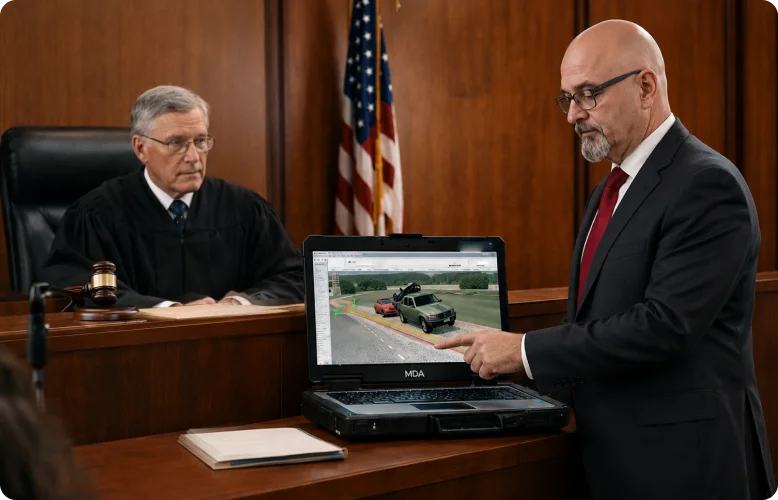
Reconstruction Outputs & Courtroom Exhibits
All outputs are developed or directly reviewed by Gerald C. McDevitt to ensure accuracy, consistency, and admissibility under legal standards.
LiDAR Point Cloud Mapping
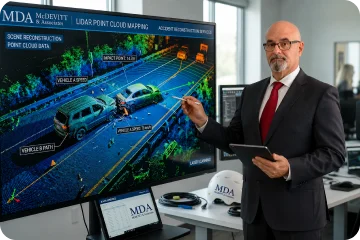
Gerald McDevitt produces high-density 3D point clouds of vehicles and limited-range scene elements using Recon3D LiDAR scanning. When third-party LiDAR point cloud data is received through discovery, it is imported and processed using FARO Zone 3D Expert Plus software. Point cloud outputs support precise measurement, scene visualization, and integration with other forensic data sources for a complete 3D record of the scene.
3D Reconstruction Models
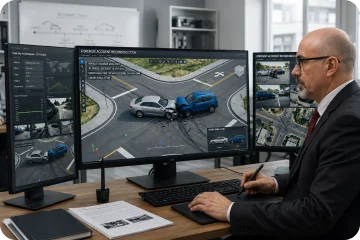
Gerald McDevitt builds court-ready 3D reconstruction models that combine Recon3D LiDAR data, Emlid RS3 GNSS positioning, Autel RTK drone photogrammetry, and Sokkia Total Station measurements. The resulting models accurately depict roadway geometry, vehicle positions, sight lines, and physical evidence in three dimensions, providing a defensible visual foundation for the analysis presented at deposition and trial.
Crash Data Retrieval (EDR/CDR Reports)
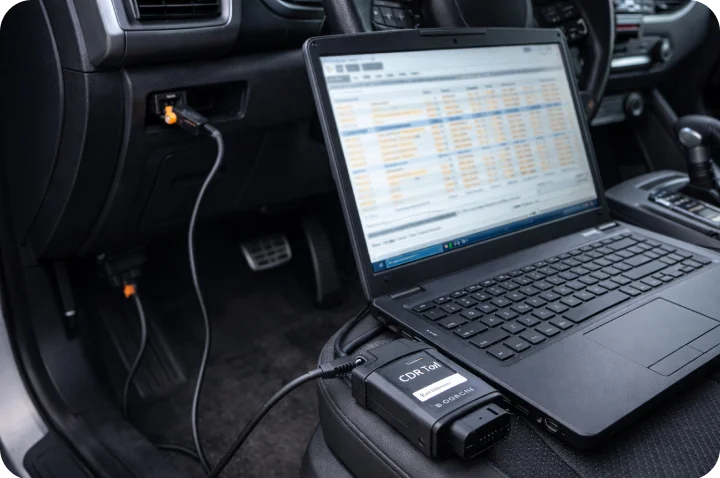
Gerald McDevitt extracts and interprets event data recorder (EDR) and airbag control module (ACM) data using the Bosch Crash Data Retrieval (CDR) system. Reports document pre-crash speed, braking application, throttle position, seatbelt status, airbag deployment timing, and delta-V — providing an objective, tamper-resistant record of vehicle behavior in the seconds before, during, and after a collision.
Courtroom Animation & Demonstratives
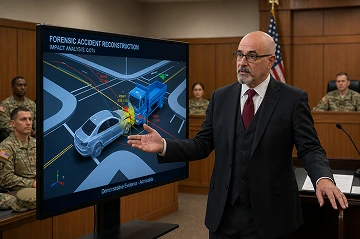
Gerald McDevitt develops 3D animations and courtroom demonstratives that translate the underlying forensic data into clear, accurate visualizations for judge and jury. Animations are built directly from the measured scene data — point clouds, GNSS coordinates, and EDR records — so that every frame is supported by the evidence and can withstand cross-examination.
CORE TECHNOLOGIES
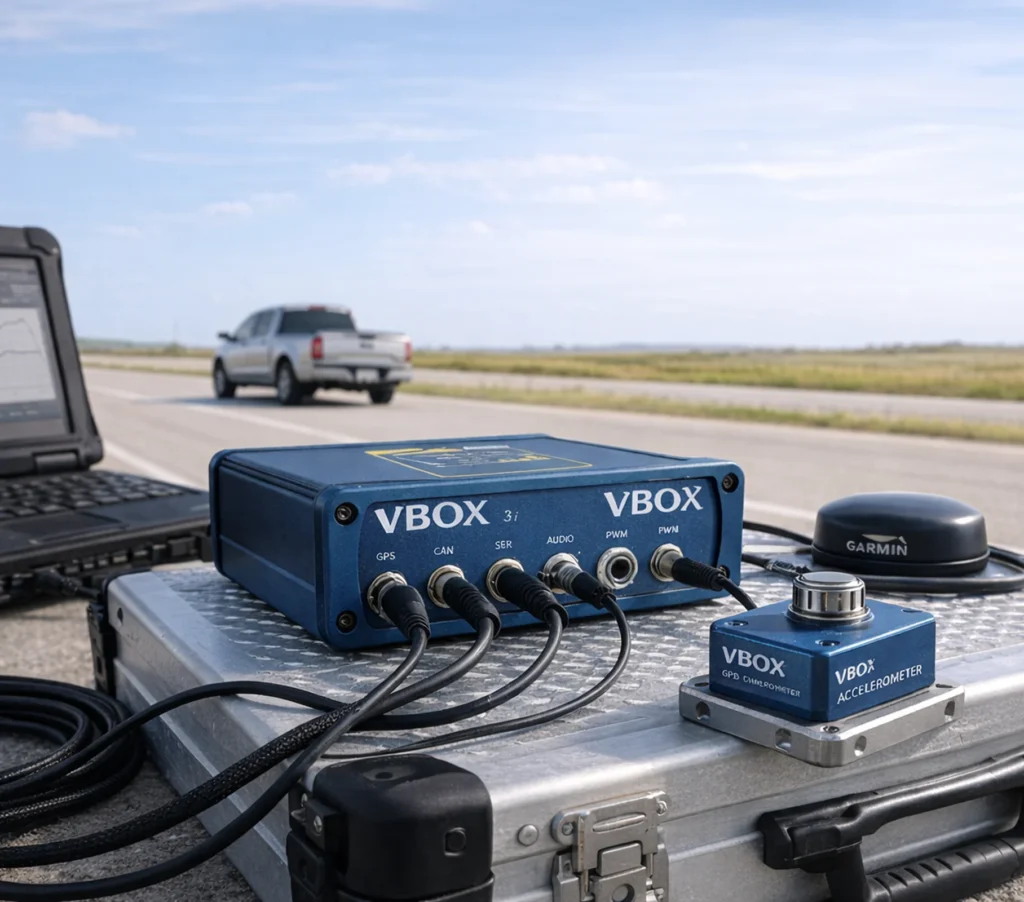
RACELOGIC VBOX GPS DATA LOGGER / ACCELEROMETER
Gerald McDevitt integrates Racelogic VBOX GPS data logger for speed and motion data as a core technology for advanced accident analysis and forensic data collection. These devices provide precise speed, acceleration, and braking data, along with accurate GPS-based position tracking before, during, and after an incident.
By capturing high-frequency motion data, this technology enables detailed reconstruction of vehicle behavior and impact dynamics. It enhances accuracy, reduces reliance on assumptions, and ensures reliable, data-driven conclusions—supporting faster and more defensible outcomes for clients.
Primary use
- Pre-impact and post-impact speed analysis
- GPS-based position tracking
- Acceleration and deceleration measurement
- Braking and motion analysis
- Forensic crash data reconstruction
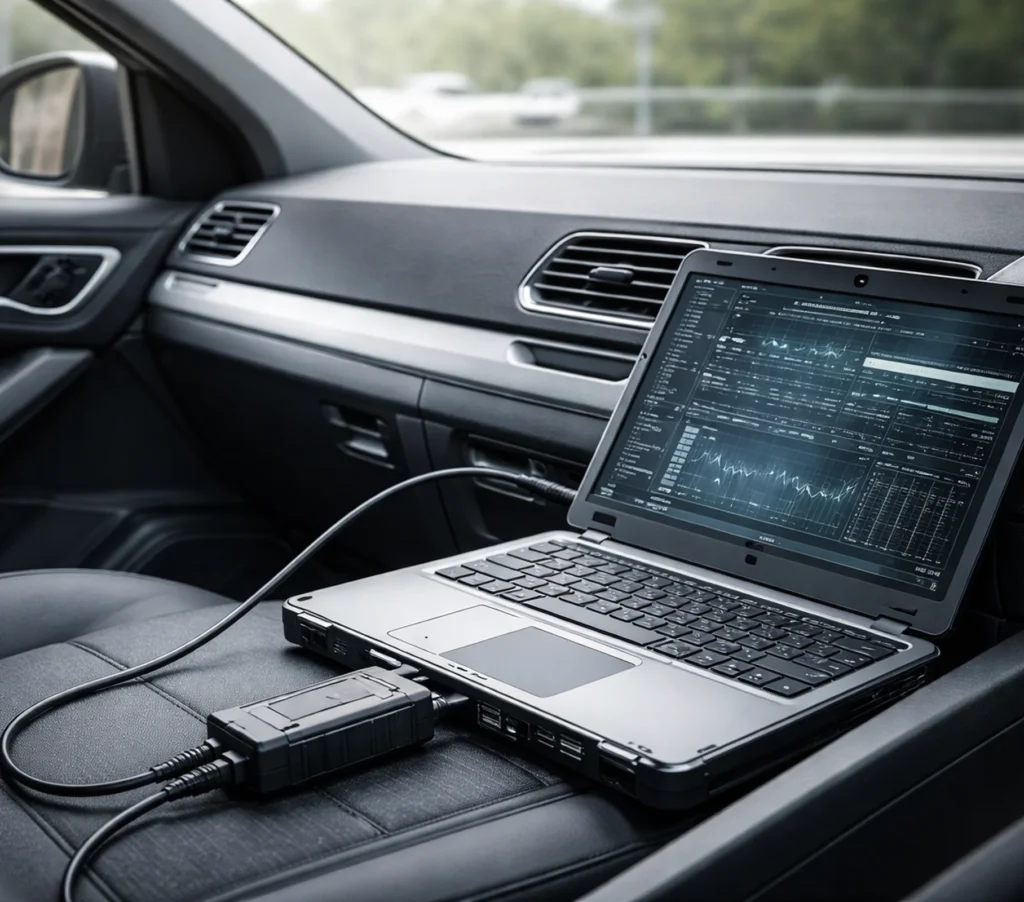
Crash Data Retrieval (EDR / CDR)
Gerald McDevitt uses the Bosch Crash Data Retrieval (CDR) system to extract critical pre-crash and crash data from a vehicle’s airbag control module (ACM) or event data recorder (EDR). This data provides an objective, tamper-resistant record of vehicle behavior in the seconds before, during, and after a collision.
EDR data is often the most decisive evidence in vehicular homicide, DUI fatality, and disputed-fault cases. The Bosch CDR tool connects directly to the vehicle’s diagnostic port or the ACM module itself, downloading a forensic snapshot that includes pre-crash speed, braking application, throttle position, seatbelt status, airbag deployment timing, and delta-V (change in velocity at impact).
All EDR extractions are performed using certified Bosch CDR hardware and software. Data interpretation is conducted by Gerald McDevitt and presented in court-ready reports suitable for deposition and trial testimony.
Primary use
- Pre-crash speed data
- Braking application and throttle position
- Seatbelt status at time of impact
- Delta-V (change in velocity at impact)
- Airbag deployment timing and sequence
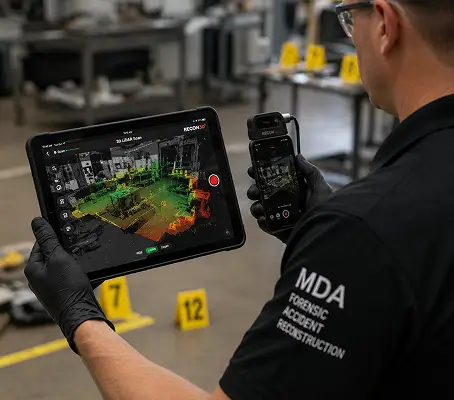
3D LIDAR SCANNING (RECON3D)
Recon3D is an iOS-based LiDAR scanning application used for fast, high-precision 3D documentation of vehicles (interior and exterior), rooms, buildings, and limited-range scene elements. Gerald McDevitt uses Recon3D to produce detailed, court-ready 3D models using the LiDAR sensor built into Apple devices. It is effective for close-to-mid-range scanning where portable, rapid documentation is needed.
Primary use
Accident and crime scene documentation where precision and clarity are critical.
Range
Effective for close-to-mid-range 3D documentation of vehicles, rooms, buildings and scene elements.
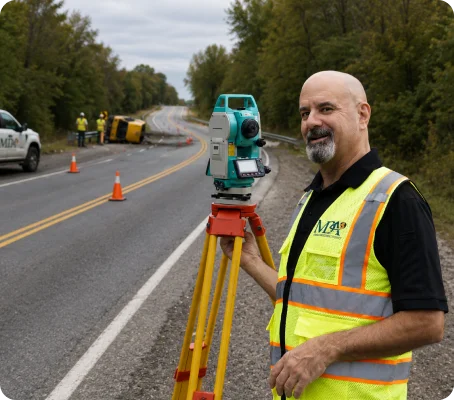
TOTAL STATION SURVEYING — SOKKIA SET330R3
Gerald McDevitt conducts scene surveys using a Sokkia SET330R3 reflectorless total station, maintained and calibrated to manufacturer specification. Reflectorless measurement allows evidence to be recorded quickly and accurately without placing personnel in the roadway.
Primary use
Evidence-grade measurement — point of impact, tire and roadway marks, gouges, fluid and debris distribution, and final rest positions.
MEASURING RANGE
Reflectorless: 0.3 to 350 m (1,140 ft) to a white target; 0.3 to 170 m (550 ft) to a gray target
Prism: 1.3 to 4,000 m (13,120 ft) with standard prism
Reflective sheet: 1.3 to 500 m (1,640 ft)
ACCURACY (fine measurement)
Prism: ±(2 + 2 ppm × D) mm
Reflective sheet: ±(3 + 2 ppm × D) mm
Reflectorless, white target: ±(3 + 2 ppm × D) mm from 0.3 to 200 m; ±(5 + 10 ppm × D) mm from 200 to 350 m
Reflectorless, gray target: ±(3 + 2 ppm × D) mm from 0.3 to 100 m; ±(5 + 5 ppm × D) mm from 100 to 170 m
Minimum display resolution: 0.001 m (0.01 ft / 1/8 inch)
(D = measurement distance)
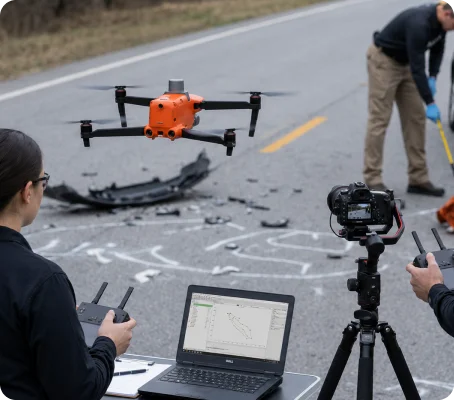
Autel EVO II Pro RTK V3 drone / UAV photogrammetry
Gerald McDevitt delivers high-precision UAV photogrammetry services designed for modern surveying and mapping workflows. Utilizing advanced drone platforms equipped with RTK/PPK geotagging, Gerald McDevitt captures accurate aerial data that produces detailed, forensic-grade outputs suitable for courtroom presentation and scientific analysis.
The process includes systematic aerial data acquisition followed by processing into orthomosaic maps, dense point clouds, and 3D surface models. This approach enables precise measurements, volumetric analysis, and site documentation with significantly faster turnaround compared to traditional methods.
Aerial data is captured with an Autel EVO II Pro RTK V3 and processed photogrammetrically into orthomosaics, dense point clouds, and three-dimensional surface models. RTK and PPK geotagging, together with ground control points established using the Emlid RS3 GNSS, tie the aerial dataset into the same coordinate framework as the total station and GNSS measurements. Aerial and ground-collected data can therefore be measured directly against one another rather than treated as separate records.
Primary use
- Aerial site documentation & surveying
- RTK-enabled high-accuracy mapping
- Orthomosaic & 3D model generation
- Dense point cloud data for analysis
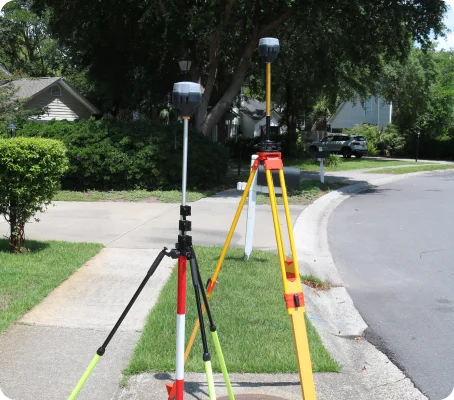
GNSS / RTK Surveying & Mapping (EMLID)
Gerald McDevitt leverages high-precision Emlid GNSS RTK systems to deliver accurate, reliable geospatial data for surveying and forensic applications. Using advanced RTK workflows, Gerald McDevitt captures precise coordinates for scene mapping, terrain modeling, and evidence documentation in real-world conditions.
The methodology ensures centimeter-level accuracy through PPK (Post-Processed Kinematic) validation, making it ideal for legal, scientific, and investigative use cases. This modern Emlid RS3 GNSS approach replaces traditional surveying inefficiencies—reducing field time while significantly improving data quality and defensibility.
Emlid RS3 GNSS is used for scene-scale mapping — roadway geometry, sight distance, grade and superelevation, ground control point placement, and overall scene extents — at centimeter-level accuracy validated through post-processed kinematic (PPK) workflows.
Primary use
- Scene mapping
- Evidence point collection
- GCP placement
- PPK accuracy documentation
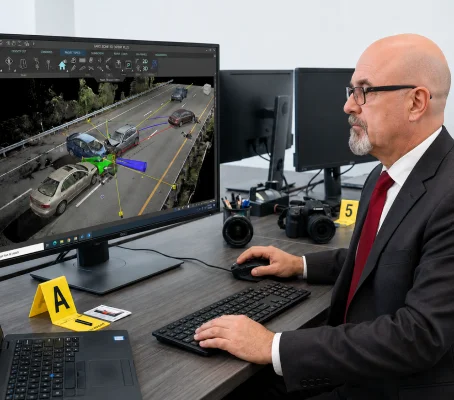
FARO ZONE 3D EXPERT PLUS
Gerald McDevitt uses FARO Zone 3D Expert Plus software for importing and processing LiDAR point cloud data received through discovery or from collaborating experts. This software enables integration of third-party LiDAR scene data into the reconstruction workflow for analysis, measurement, and courtroom presentation.
Primary use
- Importing and processing LiDAR point cloud data
- Scene measurement and analysis from third-party scans
- Integration with reconstruction software.
Technology Used by Gerald C. McDevitt
Every dataset, model, and reconstruction presented in court is developed under the direct oversight of Gerald C. McDevitt — ensuring it meets the highest standards of forensic reliability and legal scrutiny.
- Court-admissible data collection methodologies
- Measurement accuracy documented per instrument and per method
- Integration of multiple data sources (LiDAR, Emlid RS3 GNSS, EDR)
- Reconstruction workflows aligned with industry standards
- Expert interpretation backed by 32+ years of experience
Data from all three survey systems is combined into a single coordinate framework, with each measurement documented to the accuracy of the instrument and method that captured it.
Discuss Your Case
If you are evaluating an accident reconstruction expert for litigation, consultation, or case review, contact Gerald McDevitt directly for a confidential discussion