

 (843) 343-4542
 gerry@mda-recon.com
 Gerald C. McDevitt
Low Delta-V Collisions and Disputed Injury Claims: What the Physics Actually Show
Low-speed impacts produce less vehicle damage but can still generate significant occupant forces — forensic reconstruction can distinguish…
High-resolution drone imagery, centimeter-accurate GNSS positioning, and 3D point cloud scanning have fundamentally changed what a reconstructionist can document and prove at trial.
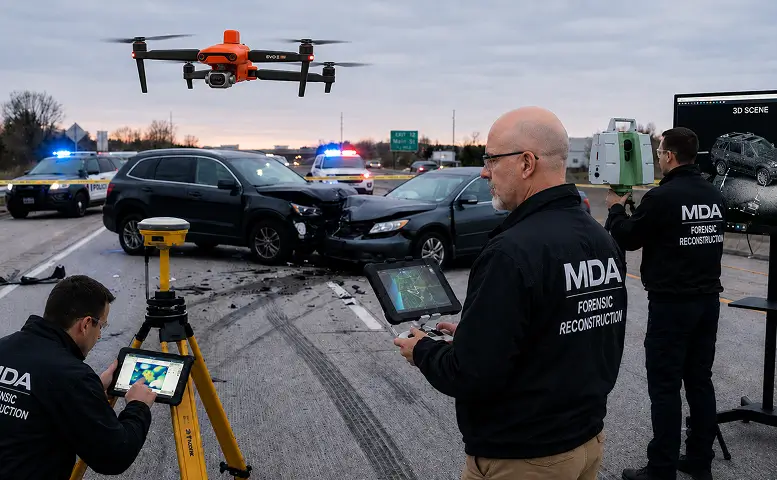
For decades, forensic scene documentation meant a team of investigators with tape measures and rolling wheels carefully plotting individual measurements at a collision scene. The results depended entirely on what the investigator decided to measure, and once the scene was cleared and the road reopened, any measurement not taken was gone forever.
Modern forensic technology has fundamentally changed that equation. The combination of GNSS satellite positioning with RTK correction, RTK-equipped drones for aerial mapping, Total Station surveying, and advanced photogrammetry processing now allows a single reconstructionist to document an entire collision scene with centimeter-level accuracy — producing comprehensive, measurable, and defensible data that can be revisited and analyzed long after the physical scene has been cleared.
GNSS (Global Navigation Satellite System) positioning is the foundation of modern forensic scene documentation. Using a base station and rover configuration with real-time kinematic (RTK) correction, GNSS receivers achieve centimeter-level positional accuracy in the field. Every evidence marker, tire mark endpoint, vehicle rest position, and roadway feature is tied to precise geographic coordinates on the earth’s surface.
This matters for several reasons. First, centimeter-level accuracy eliminates the measurement uncertainty that opposing counsel might exploit when challenging scene documentation. Second, geographic coordinates allow the scene data to be integrated directly with aerial imagery, mapping databases, and satellite photos for verification and courtroom presentation. Third, the data is permanent and reproducible — any qualified expert can return to those exact coordinates and verify the measurements.
Perhaps the most significant advancement in forensic scene documentation is the use of RTK-equipped drones for aerial mapping. A drone flown over a collision scene captures hundreds of high-resolution overlapping photographs from directly above the site. These images are then processed through photogrammetry software to produce detailed orthomosaic maps — geometrically corrected aerial images where every pixel is accurately positioned — and 3D terrain models of the entire scene.
The result is a complete, measurable aerial view of the collision scene at a level of detail that no ground-level photograph can achieve. Tire marks, gouge marks, debris patterns, vehicle positions, lane markings, intersection geometry, sight lines, and roadway conditions are all captured in a single dataset. Measurements can be taken from the orthomosaic at any time, from any point to any other point, without returning to the scene.
When combined with RTK-corrected GNSS ground control points, the drone-produced orthomosaic achieves the same centimeter-level accuracy as traditional ground survey methods — but covers the entire scene rather than just the specific points the investigator chose to measure. This is a fundamental shift in completeness: instead of documenting individual data points, the reconstructionist documents everything.
Total Station survey equipment remains an essential component of forensic scene documentation, particularly for precise measurements of specific evidence items, roadway cross-sections, grade calculations, and areas where line-of-sight from the air may be obstructed by tree canopy or structures. The Total Station provides angular and distance measurements to individual points with millimeter-level precision.
In modern forensic practice, the Total Station works in combination with GNSS and drone data rather than as a standalone tool. Ground-level survey points supplement and validate the aerial data, creating a multi-source dataset where each technology’s strengths complement the others. The result is a scene documentation package that is more complete, more accurate, and more defensible than any single technology could produce alone.
Scene documentation is only part of the forensic picture. Understanding how vehicles behave on a specific roadway — braking distances, friction characteristics, vehicle response in curves and lane changes — requires field testing with precision instrumentation. Accelerometer-based vehicle dynamics systems capture real-time data including speed, acceleration, deceleration, lateral forces, and GPS position during controlled test runs on the roadway where the collision occurred.
This data can be overlaid directly onto synchronized video footage — both ground-level and aerial drone video — producing courtroom demonstratives that show the data in motion. A judge or jury watching an aerial flyover of the collision scene with real-time speed, position, and braking data displayed on screen gains an intuitive understanding of the physics involved that no static diagram or verbal explanation can provide. This telemetry overlay capability transforms raw forensic data into visual presentations that make complex technical findings accessible to non-technical audiences.
Collision reconstruction sometimes requires detailed documentation of vehicle interiors, building interiors, or confined spaces where traditional survey methods are impractical. Handheld 3D scanning technology creates precise spatial models of these environments, capturing dimensions, spatial relationships, and physical evidence in a format that can be measured and analyzed.
This capability is also valuable for documenting vehicle damage from the interior perspective — intrusion measurements, occupant compartment dimensions, and the spatial relationship between vehicle components and the occupant’s seating position. When combined with exterior scene data, interior 3D scans provide a complete picture of both the environment and the vehicle involved in the collision.
Many law enforcement agencies, government investigators, and other forensic experts document collision and crime scenes using terrestrial laser scanners that produce dense 3D point clouds containing millions of precisely located data points. When this scanner data is part of the discovery materials in a case, a qualified reconstructionist can import, process, and analyze the point cloud data using specialized software — extracting measurements, generating cross-sections, and integrating the data with other evidence sources. The ability to work with laser scanner data received through discovery ensures that no available evidence goes unused, regardless of what technology was originally used to capture it.
For the attorney evaluating a reconstruction expert, the technology used for scene documentation matters because it directly affects the quality, completeness, and defensibility of the forensic work product.
Completeness. Drone-based aerial mapping captures the entire scene, not just the points the investigator decided to measure. If a question arises six months into litigation about a sight line, a grade, or the position of a roadway feature, the answer is already in the data.
Accuracy. GNSS with RTK correction and Total Station surveying deliver centimeter-level and millimeter-level precision respectively. This level of accuracy eliminates measurement disputes and meets the documented error rate requirements that Daubert demands.
Preservation. A collision scene is temporary. The road reopens, vehicles are towed, weather degrades evidence. Drone orthomosaics, GNSS data, and survey measurements preserve the scene permanently in a measurable, digital format that can be revisited as many times as the case requires.
Courtroom presentation. Aerial scene maps, telemetry-overlaid video, and 3D models transform complex spatial relationships into visual presentations that judges and juries understand intuitively. These demonstratives make the technical findings accessible to non-technical audiences — which is ultimately what wins cases.
When evaluating a reconstruction expert for a serious collision case, ask what technology they deploy to the scene. An expert who uses GNSS with RTK correction, RTK-equipped drones for aerial mapping, Total Station surveying, vehicle dynamics testing with telemetry overlay, and 3D scanning is producing a fundamentally more complete, more accurate, and more defensible work product than one relying on outdated methods. In litigation where millions of dollars or criminal liberty is at stake, the quality of the scene documentation is the foundation on which everything else is built. That foundation should be the strongest one available.
32+ years of experience. Hundreds of fatal collision reconstructions. Qualified in state, federal, and military courts.
Gerald C. McDevitt
Low-speed impacts produce less vehicle damage but can still generate significant occupant forces — forensic reconstruction can distinguish…
 Gerald C. McDevitt
Proving that impairment caused a fatal collision — not just that the driver was impaired — requires a…
 Gerald C. McDevitt
A vehicle cannot leave a scene without leaving evidence — paint transfer, glass, tire impressions, and debris patterns…
 Gerald C. McDevitt
Tractor-trailer and fleet vehicle collisions involve federal regulatory requirements, electronic logging devices, and complex vehicle dynamics that demand…