


 (843) 343-4542
 gerry@mda-recon.com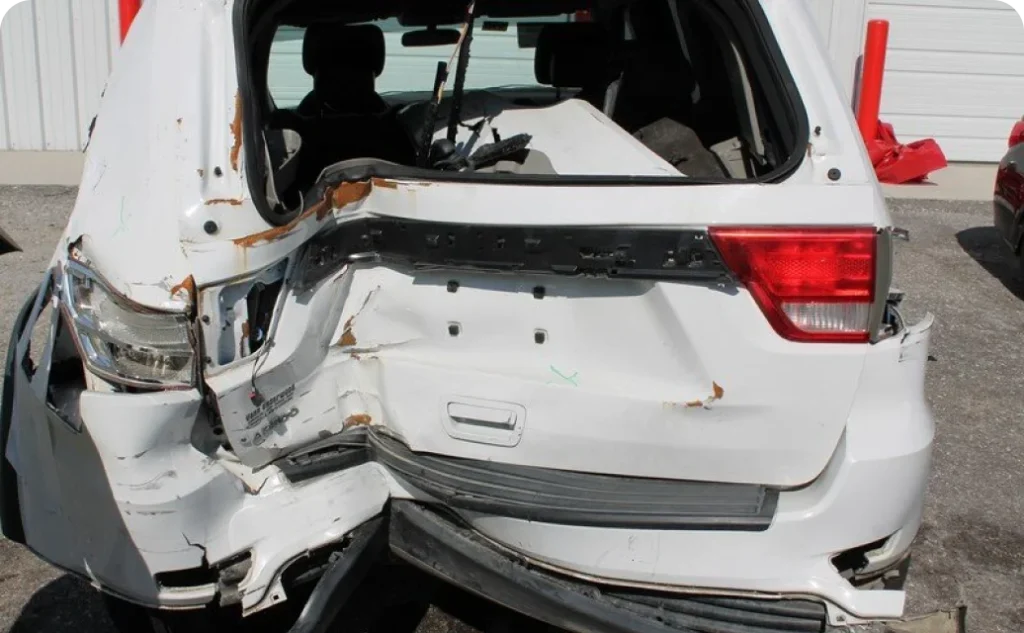
 Gerald C. McDevitt
Low Delta-V Collisions and Disputed Injury Claims: What the Physics Actually Show
Low-speed impacts produce less vehicle damage but can still generate significant occupant forces — forensic reconstruction can distinguish…
Proving that impairment caused a fatal collision — not just that the driver was impaired — requires a level of forensic analysis that goes well beyond the toxicology report.
Felony DUI and vehicular homicide cases sit at the intersection of traffic collision reconstruction and criminal law. The physical evidence must establish what happened at a level of scientific certainty sufficient to support criminal conviction. The analysis must address causation with precision, because the central question is often whether the driver’s conduct — not just impairment, but the specific operational choices the driver made — caused the death or serious injury at issue. And the reconstruction must survive the most rigorous cross-examination in the criminal docket, because the liberty of the accused and the justice owed to the victim depend on it.
Gerald McDevitt has worked DUI and vehicular homicide cases for both prosecution and defense across state and federal courts. The methodology is the same regardless of the retaining party: rigorous scientific analysis of the physical evidence, careful distinction between what the evidence establishes and what it does not, and findings that can be defended under Daubert or Frye admissibility standards and examined under oath in the most contested courtroom environment in American law.
The reconstruction of an impaired-driver collision differs from a routine traffic reconstruction in several important respects. The burden of proof in a criminal case is substantially higher than in civil litigation. Causation must be established with a level of scientific rigor sufficient to sustain a conviction. The interaction between impairment and driver conduct must be addressed carefully: the expert must avoid conflating the fact of impairment with the question of causal contribution. And the record must be built with the expectation that every assumption, every measurement, and every calculation will be challenged.
Prosecutors need reconstructions that establish causation with the scientific rigor sufficient to support a conviction beyond reasonable doubt. Defense counsel need reconstructions that test the prosecution’s theories against the actual physical evidence, identify alternative explanations the scene evidence may support, and hold the state’s case to the standard of proof the law requires. Both sides benefit from an expert whose findings are scientifically grounded rather than adversarial in posture.
One of the most important analytical distinctions in a DUI or vehicular homicide case is the difference between impairment and causation. The fact that a driver was impaired does not, by itself, establish that the impairment caused the collision. A driver with a measurable blood alcohol concentration may have been struck by another vehicle under circumstances that gave no reasonable driver time to react. A driver under the influence may have been operating within posted speed limits on the correct side of the road when another party’s actions produced the collision. The reconstruction expert’s responsibility is to determine what the physical evidence shows about causation — independent of the impairment evidence — and to identify honestly whether the impairment contributed to the outcome.
This analysis is done through the standard reconstruction methodology: pre-crash speed from event data recorder evidence, braking and steering input from EDR data and roadway evidence, sight-line analysis, perception-response time evaluation, and comparison of documented driver behavior against the reasonable driver standard. If the reconstruction shows that a sober driver operating under identical conditions would have had sufficient time and distance to perceive and avoid the hazard — and that the subject driver did not take effective action — the reconstruction supports a causation theory grounded in operational failure. Whether that operational failure is attributable to impairment is then a question the trier of fact evaluates based on the impairment evidence separately.
Conversely, if the reconstruction shows that the collision would have occurred regardless of whether the driver was impaired — because the hazard appeared with insufficient time for any reasonable driver to respond — the expert’s analysis supports a different conclusion about causation. This kind of finding can be decisive in a defense case, and it is the kind of finding that requires intellectual honesty from the expert regardless of which side is paying the bill.
Event data recorder information is frequently the most decisive evidence in a DUI or vehicular homicide reconstruction. EDR data captured at the moment of impact documents pre-crash vehicle speed, throttle position, brake application, steering input, seatbelt status, and the change in velocity experienced during the collision. In cases where the central question is whether the driver was operating at excessive speed, failed to brake, or failed to take evasive action, EDR data provides objective evidence that stands independent of witness accounts and physical reconstruction.
For prosecution, EDR evidence can establish the elements of the offense with precision: excessive speed relative to conditions, failure to apply brakes before impact, failure to take evasive action when time and space permitted. For defense, the same data can demonstrate that the driver did apply brakes, did attempt evasive action, or was operating within reasonable limits — facts that may undermine the prosecution’s causation theory.
EDR extraction in criminal cases requires strict attention to chain of custody. The vehicle must be documented in its post-collision condition. The download procedure must be performed with properly maintained equipment and current software. The extracted data must be preserved in its original form with appropriate documentation. Gerald McDevitt uses Bosch Crash Data Retrieval with the chain-of-custody documentation that criminal litigation requires.
Perception-response analysis is central to most DUI and vehicular homicide reconstructions. The question is typically whether the driver had sufficient time and distance to perceive the hazard and take effective action — and whether the driver’s actual response was consistent with that of a reasonably attentive driver.
The published research on perception-response time establishes baseline values for various hazard scenarios, ambient conditions, and driver populations. A reconstruction expert translates these values into the specific facts of the case: given the distance at which the hazard became reasonably detectable, the vehicle’s closing speed, and the time required for perception and response, could a reasonably attentive driver have avoided the collision?
The published research also addresses the effects of alcohol and drug impairment on perception-response time, attention, and judgment. Where the case requires analysis of how impairment specifically modified perception-response, retaining counsel may engage a toxicology or addiction medicine specialist to address that question separately. The reconstruction findings can then be integrated with the impairment analysis to produce a combined causation theory. This is how the reconstruction supports or tests a theory that impairment contributed to causation.
Beyond the standard reconstruction evidence, DUI and vehicular homicide cases often involve physical evidence with particular significance. Lane departure patterns — whether the subject vehicle was drifting within its lane, crossing into oncoming traffic, or traveling on the shoulder before impact — can support inferences about driver attention and control. The absence of braking evidence at a scene where braking would have been expected from a sober driver is itself a piece of evidence. The presence of pre-impact yaw or loss-of-control marks in situations that should not have produced them suggests operational failure consistent with impairment.
Secondary-impact evidence — where a vehicle strikes a fixed object after the initial collision without any apparent attempt at control — can indicate impaired driver response even in the immediate post-impact period. Rollover analysis in single-vehicle DUI cases often turns on whether the vehicle’s speed and input history support a theory of driver-induced loss of control versus an unavoidable environmental factor.
Scene documentation in these cases must be comprehensive because the prosecution’s burden of proof demands it and the defense’s obligation to test that proof demands it. Gerald McDevitt uses the full documentation suite — Emlid RS3 GNSS, Sokkia Total Station, Autel EVO II Pro RTK V3 drone aerial photogrammetry, Recon3D LiDAR scanning, Bosch Crash Data Retrieval, and Racelogic VBOX GPS data logger for supplementary testing — to build the record each case requires.
Gerald McDevitt works both sides of DUI and vehicular homicide cases, and the methodology is identical regardless of the retaining party. Prosecutors retain him to establish causation with scientific rigor sufficient to support conviction beyond reasonable doubt. Defense counsel retain him to test the state’s reconstruction against the physical evidence, identify alternative explanations, and evaluate whether the prosecution’s theory survives scientific scrutiny.
The dual-role experience itself matters. An expert who works only prosecution cases is vulnerable to the claim that his analysis is adversarially shaped toward the state’s theory. An expert who works only defense cases is vulnerable to the corresponding claim from the prosecution side. An expert who works both — and whose findings follow the evidence rather than the retention — carries credibility that a one-sided expert cannot match. This credibility becomes particularly valuable under cross-examination, where the question “isn’t it true you always find for the prosecution?” — or the defense equivalent — has no traction against a record of objective work.
A DUI or vehicular homicide reconstruction can determine pre-crash vehicle speed, driver inputs, braking and evasive action, perception-response timing relative to published values, and whether the physical conditions allowed a reasonably attentive driver to perceive and respond effectively to the hazard. The expert can also opine on whether the documented driver conduct is consistent with the kind of operational failure that impairment research associates with measurable alcohol or drug concentrations.
A reconstruction expert cannot determine whether any specific driver was subjectively impaired at the moment of collision — that is the province of toxicology and chemical analysis. The expert cannot determine the intent or conscious decision-making of the driver. And the expert cannot cross the line from analyzing driver conduct to pronouncing on criminal responsibility. The reconstruction provides the physical and scientific framework; the jury applies that framework to the question of guilt.
DUI and vehicular homicide cases are where the discipline of accident reconstruction meets the demands of criminal litigation. The evidence must be rigorous. The analysis must separate what the physical evidence shows from what it does not. The expert must be prepared to testify under the most demanding cross-examination in American law. For prosecutors building cases against impaired drivers, for defense counsel holding the state to its burden of proof, and for civil counsel pursuing wrongful death actions arising from impaired-driver collisions, a qualified reconstruction expert provides the objective physical framework on which these cases ultimately turn.
1970 Armory Drive, Mount Pleasant, SC 29466
Gerald C. McDevitt
Low-speed impacts produce less vehicle damage but can still generate significant occupant forces — forensic reconstruction can distinguish…
 Gerald C. McDevitt
A vehicle cannot leave a scene without leaving evidence — paint transfer, glass, tire impressions, and debris patterns…
 Gerald C. McDevitt
Tractor-trailer and fleet vehicle collisions involve federal regulatory requirements, electronic logging devices, and complex vehicle dynamics that demand…
 Gerald C. McDevitt
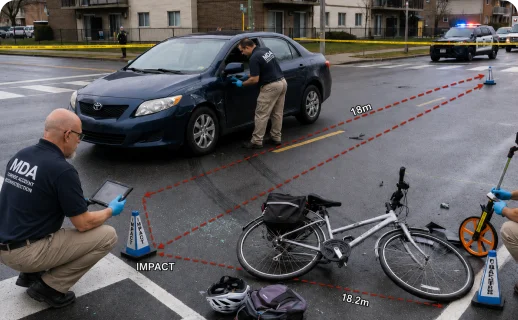
When a pedestrian or bicyclist is struck by a vehicle, the body's trajectory, throw distance, and impact kinematics…